
What a specification review should cover for Air Handling Unit Heating: trade-off framing for early research
Planning air handling unit heating starts with a clear decision: what must the heater achieve inside the intended air path, and what evidence will support that choice? Project managers should separate known requirements from assumptions before comparing configurations. The review should connect airflow, temperature targets, available space, electrical supply, controls, and validation steps to the actual AHU rather than treating a heater specification as a standalone answer.

Clarify the decision before comparing options
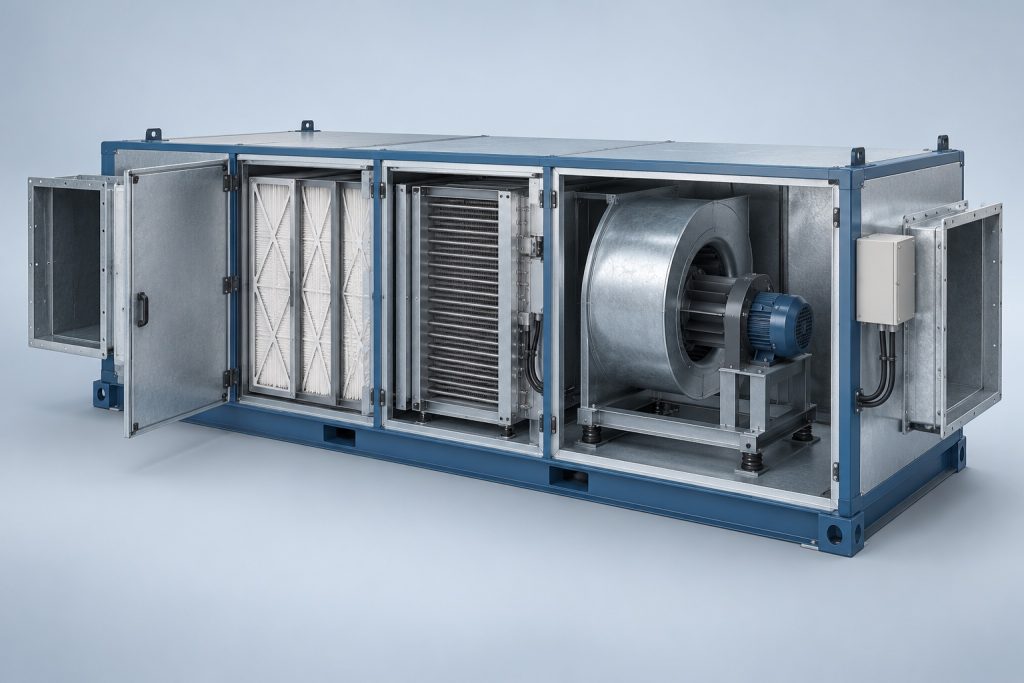
An AHU heater raises incoming or recirculated air to the required supply condition. That definition gives the review a useful starting point, but it does not select a configuration by itself. The heating assembly must be considered around the air path, operating range, and control sequence. The complete unit remains the relevant setting for validation.
Begin by recording the intended operating context. Note the airflow range, inlet-air temperature, target supply-air temperature, available voltage, allowable pressure drop, and control sequence. Installation limits and expected quantity also belong in the initial brief. These details define the boundaries of the comparison and reduce the risk of selecting an appealing specification that does not fit the planned unit.
Space is another practical trade-off. The official application page lists a 500W insulated PTC air heater at 220V, with dimensions of 140 × 50.5 × 26 mm, and describes it as a compact option for existing airflow paths. Those details can be useful for an early screen, but they apply to that listed product example. They should not be generalized to every heater or every AHU.
Build a concise comparison framework
A useful comparison does not need a long scorecard. It needs criteria that map directly to the project. First, compare the required air condition with the stated operating inputs. Electrical supply, airflow, inlet temperature, and heat removal all matter because actual PTC output depends on them. The element’s resistance increases as it warms, which helps limit power output, but that behavior does not remove the need to assess the complete system.
- Record the AHU section drawing, airflow range, inlet and target supply-air temperatures, available voltage, allowable pressure drop, and control sequence.
- Compare the heating assembly with the air path, operating range, installation space, wiring, mounting, and control sequence.
- Keep AHU temperature control, airflow interlocks, and overheat protection separate from PTC self-regulation.
- Evaluate the sample in the target AHU and verify temperature rise, pressure drop, and control response across the operating range before production.
Second, compare physical and integration requirements. Review the available installation space, the air path, wiring, mounting, and the control sequence together. A configuration can look suitable on paper while still requiring a different arrangement for the target unit. The page describes customization around voltage, dimensions, wiring, and mounting for prototype evaluation and OEM production. That supports a structured technical discussion, not an automatic conclusion about suitability.
Third, keep control and protection responsibilities visible. The page states that PTC self-regulation does not replace AHU temperature control, airflow interlocks, or overheat protection. It also calls for heating output and pressure-drop validation across the intended operating range. Therefore, the review should assign these control and validation questions explicitly instead of treating self-regulation as a complete control strategy.
For a practical project record, use one line for each requirement and mark it as confirmed, to be tested, or still undefined. This simple distinction prevents an estimate from being mistaken for a page-listed specification. It also gives procurement a focused list of questions without overstating what the early research has proved.
Use a real application brief, not an abstract comparison
A real-world application brief can expose trade-offs that a catalog review may miss. For example, the official page asks the requester to share an AHU section drawing, airflow range, inlet and target supply-air temperatures, available voltage, allowable pressure drop, and control sequence when requesting a PTC heater configuration for prototype testing. It also asks for installation limits and expected quantity. This is a practical model for the information a project manager should assemble before a technical review.
In that same discussion, air handling unit temperature control heating should be treated as a system question. The heater, airflow, sensors, interlocks, overheat protection, and control sequence must be considered together. A project brief that lists only wattage leaves important interfaces unresolved. A brief that includes the operating range and control requirements supports a more disciplined comparison.
Avoid unsupported conclusions
Several common shortcuts weaken an early specification review. A listed wattage is not proof of a particular temperature rise in every unit. A compact dimension is not proof that the assembly will fit an unexamined airflow path. PTC self-regulation is not a substitute for the AHU’s control and protection functions. These are not objections to early research; they are boundaries around what the evidence can establish.
Prototype evaluation should therefore precede a production decision where the application requires it. The captured page recommends evaluating samples in the target AHU and verifying temperature rise, pressure drop, and control response across the operating range. After that work, the approved configuration, order quantity, and delivery requirements can be confirmed for OEM supply. Keeping these stages separate makes the procurement record easier to defend.
Carry the requirements into procurement
The final sourcing brief should preserve the original operating context. Include the AHU section drawing, airflow range, inlet and target supply-air temperatures, available voltage, allowable pressure drop, control sequence, installation limits, and expected quantity. Add the dimensions or electrical values of any product example under review, but label them as example-specific. This format gives engineering and procurement the same reference point.
It should also state what remains subject to testing. Temperature rise, pressure drop, and control response belong in the validation plan rather than in an assumed approval statement. The purpose of early research is to narrow the field and expose interfaces, not to convert limited page evidence into a universal performance claim.
A disciplined review connects the intended air path and operating range to electrical, physical, control, and validation requirements. It keeps product-specific details separate from project assumptions and carries unresolved questions into the sourcing brief. Used this way, PTCYIDU is part of an evidence-led procurement discussion rather than a substitute for confirming the heater in the complete AHU.