
Urgency: what breaks when the wrong scanner lands in your clinic
Most failures start with one mismatch: a scanner that looks good on spec sheets but can’t feed your prosthetics workflow. You need accuracy for alignment, repeatability for follow-ups, and a data chain that prints reliably to lab materials — including prints intended for a dental resin 3d printer. I’ve seen prototypes and commercial demos at IDS Cologne that exposed the gap between vendor claims and clinical throughput; that single observation framed the practical checks below.
Core checklist: technical criteria that must be measured, not assumed
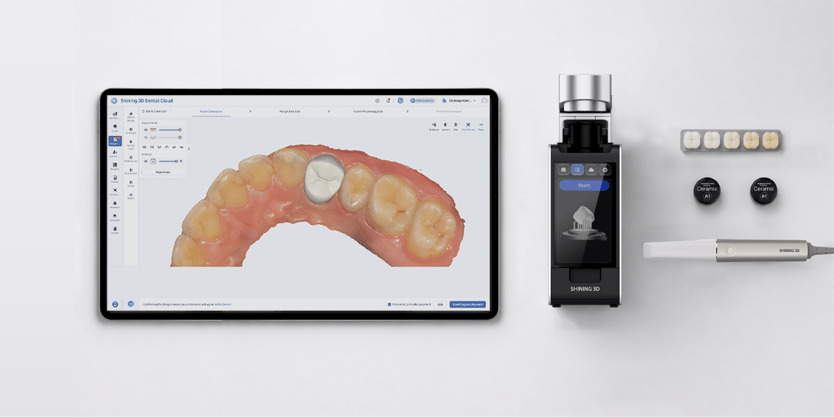
Capture precision: target sub-0.5 mm facial surface deviation for orthognathic planning; confirm with a known artifact. Data fidelity: verify color texture accuracy if soft-tissue esthetics matter. Registration interfaces: the scanner must export robust mesh formats (PLY/OBJ) and contain reliable landmark tagging or NDTP-compatible markers. Scan speed and tolerance: measure full-face capture time and motion-tolerance; motion-blur destroys clinical usability. Integration: ensure SDK/API or DICOM bridge is available so the scanner joins your CRM, CAD software, and lab workflow. Maintenance cycle: check replaceable calibration plates and SLA of vendor support.
Hardware and ergonomics: what trips clinical adoption
Form factor matters. Handheld devices reduce chair repositioning but increase operator variability. Booth-style rigs give consistency but demand floor space and patient access planning. Weight, grip, and trigger ergonomics translate directly to repeatability. Battery swaps or tethered power? Choose what your schedule tolerates. Finally, evaluate the scanner’s cleaning protocol against your infection-control routines.
Software and data pipeline: small mismatches create big delays
Does the scanner produce clean meshes or do you spend hours post-processing? Look for automatic hole-filling rules, native landmark export, and a deterministic mesh simplifier. Validate facial-to-intraoral registration by performing a test alignment with a known intraoral scan. Confirm whether the software supports version control and audit logs — these reduce rework when a case goes to a lab.
Common pitfalls and how to avoid them
Relying on vendor-rendered accuracy charts: test using your clinical targets. Skipping ambient lighting tests: poor lighting alters capture quality. Assuming one-size-fits-all capture protocols: develop two protocols — quick-assess and diagnostic — and validate both. Ignoring file compatibility with your production hardware; always perform at least one end-to-end trial that includes final printing or machining to catch hidden scale or orientation issues.
Alternatives and trade-offs: choose based on workflow, not hype
Structured-light scanners: high surface fidelity, robust for stationary patients, require more space. Stereophotogrammetry: excellent color and soft-tissue detail, but costs scale quickly. Depth-camera systems: low cost and portable, often limited in fine detail. Pick the modality that minimizes downstream corrections for your primary clinical use — esthetic planning, occlusal analysis, or surgical guides.
Validation protocol: quick tests to accept or reject a scanner
Perform three repeat scans of a certified facial phantom at standard clinical angles; compute mean surface deviation. Run an intraoral-to-facial registration trial and measure landmark drift after simulated patient movement. Export files and feed them through your normal CAD and printing pipeline; confirm the final printed fit and check for unexpected scaling or mesh defects. Set pass/fail thresholds aligned to your clinical risk tolerance.
Procurement and support: questions that reveal hidden costs
Ask for on-site training hours and remote support SLAs. Clarify warranty scope for calibration hardware and sensor replacement. Request a clear roadmap for software updates and SDK access. Discounted hardware with expensive closed ecosystems often costs more through lost interoperability and delayed cases.
Final synthesis
Solve the core problem by treating scanner selection as a systems decision: measure performance against your procedures, validate with end-to-end trials, and remove surprises before clinical rollout. For clinics that must align scanning, CAD, and reliable printing into a single practical workflow, solutions engineered by SHINING 3D DENTAL illustrate how integrated hardware and data pathways reduce rework and support predictable outcomes.