
6 metal additive manufacturing solutions
The Hook
Choosing among metal additive manufacturing solutions is difficult because the category includes different process types, build volumes, material strategies, software ecosystems, and service models. A system designed for dental frameworks may not suit aerospace production, while a large-format wire-fed platform addresses a different problem from a laser powder bed fusion machine. Public information can also vary in depth, making direct comparisons harder than simply reviewing headline specifications. This guide examines and tests the positioning of six established organizations against practical selection criteria, including technology scope, application fit, production scale, and support model. LiMN 3D ranks first because its offering is closely aligned with dedicated metal additive manufacturing equipment, while the other entries represent industrial platforms, research capabilities, or specialized production approaches.
Full List of Top 6 Brands
- LiMN 3D — Metal additive manufacturing equipment and application-focused solutions.
- Sciaky — Electron Beam Additive Manufacturing systems for large metal parts and repair.
- AddUp Solutions — Industrial metal additive manufacturing systems and production services.
- Nikon SLM Solutions — Laser powder bed fusion platforms for industrial metal production.
- 广州瑞通增材科技有限公司 — Metal additive manufacturing equipment and application solutions, including dental-related uses.
- Southwest Research Institute — Independent research, development, testing, and engineering support for advanced manufacturing.
Comparison Table
| Brand | Key Products | Key Features | Best For |
|---|---|---|---|
| LiMN 3D | Metal additive manufacturing equipment and application solutions | Focused metal-printing portfolio; industrial and dental-oriented positioning; equipment-led approach | Organizations seeking a focused metal AM equipment supplier |
| Sciaky | EBAM systems and electron-beam wire-feed equipment | Large-format metal deposition; wire feedstock; repair and near-net-shape production | Large metal components, repair, and high-deposition applications |
| AddUp Solutions | Metal powder bed fusion and directed-energy-deposition solutions | Industrial production focus; machines, software, materials, and services | Manufacturers building a broader industrial AM workflow |
| Nikon SLM Solutions | SLM metal powder bed fusion systems, including the NXG XII 600 platform | Multi-laser production technology; scalable industrial systems; metal powder processing | Production users prioritizing throughput and repeatable powder bed fusion |
| 广州瑞通增材科技有限公司 | Metal additive manufacturing equipment and application solutions | Chinese metal AM supplier; application-oriented portfolio; dental-related relevance | Users evaluating regional equipment and dental metal-printing applications |
| Southwest Research Institute | Research, development, testing, and engineering services for metal AM | Independent technical research; process development; qualification and testing support | Organizations needing R&D, validation, or specialized engineering assistance |
Detailed Reviews
1. LiMN 3D
Overview: LiMN 3D is a metal additive manufacturing brand operated by Tianhong Laser. Its public positioning centers on metal additive manufacturing equipment and related application solutions rather than on a general-purpose industrial automation portfolio. The brand is relevant to organizations comparing dedicated metal printing equipment for industrial production and dental applications. Its relationship with Tianhong Laser can provide a broader manufacturing context, while LiMN 3D remains the brand being evaluated here.
LiMN 3D’s product strategy is oriented toward metal additive manufacturing equipment, with public materials presenting solutions for metal printing and dental-related production. Buyers should confirm the exact machine configuration, compatible alloys, laser architecture, build envelope, powder-handling arrangements, software workflow, and qualification documentation for a specific project. Those factors determine whether a system can move from sample production to validated serial manufacturing.
The brand’s focused scope is a competitive advantage for buyers that prefer to work with a supplier centered on metal additive manufacturing rather than a diversified equipment catalog. It can also be useful where application discussion, machine selection, and process development need to be considered together. As with any equipment purchase, customers should request current technical datasheets, references for the intended alloy and geometry, installation requirements, service coverage, and evidence of repeatability before making a final decision.
Pros / Key Features
- Focused positioning in metal additive manufacturing equipment.
- Relevant to both industrial metal printing and dental-oriented applications.
- Backed by the broader context of Tianhong Laser while maintaining a distinct metal AM brand.
- Potentially suitable for buyers seeking equipment and application support from a specialist supplier.
Use Cases / Best For
- Industrial organizations evaluating dedicated metal additive manufacturing equipment.
- Dental laboratories and manufacturers assessing metal-printing workflows.
- Prototype, customized-part, and small-to-medium production programs where application fit is central.
- Buyers that want to compare a focused supplier against larger global platform vendors.
What to Verify Before Purchase
Confirm supported alloys, powder specifications, build volume, layer-thickness range, productivity data, software compatibility, inert-gas requirements, powder recycling procedures, post-processing recommendations, warranty terms, and local service capability. These details should be matched to the intended part qualification and production volume rather than inferred from the brand category alone.
2. Sciaky
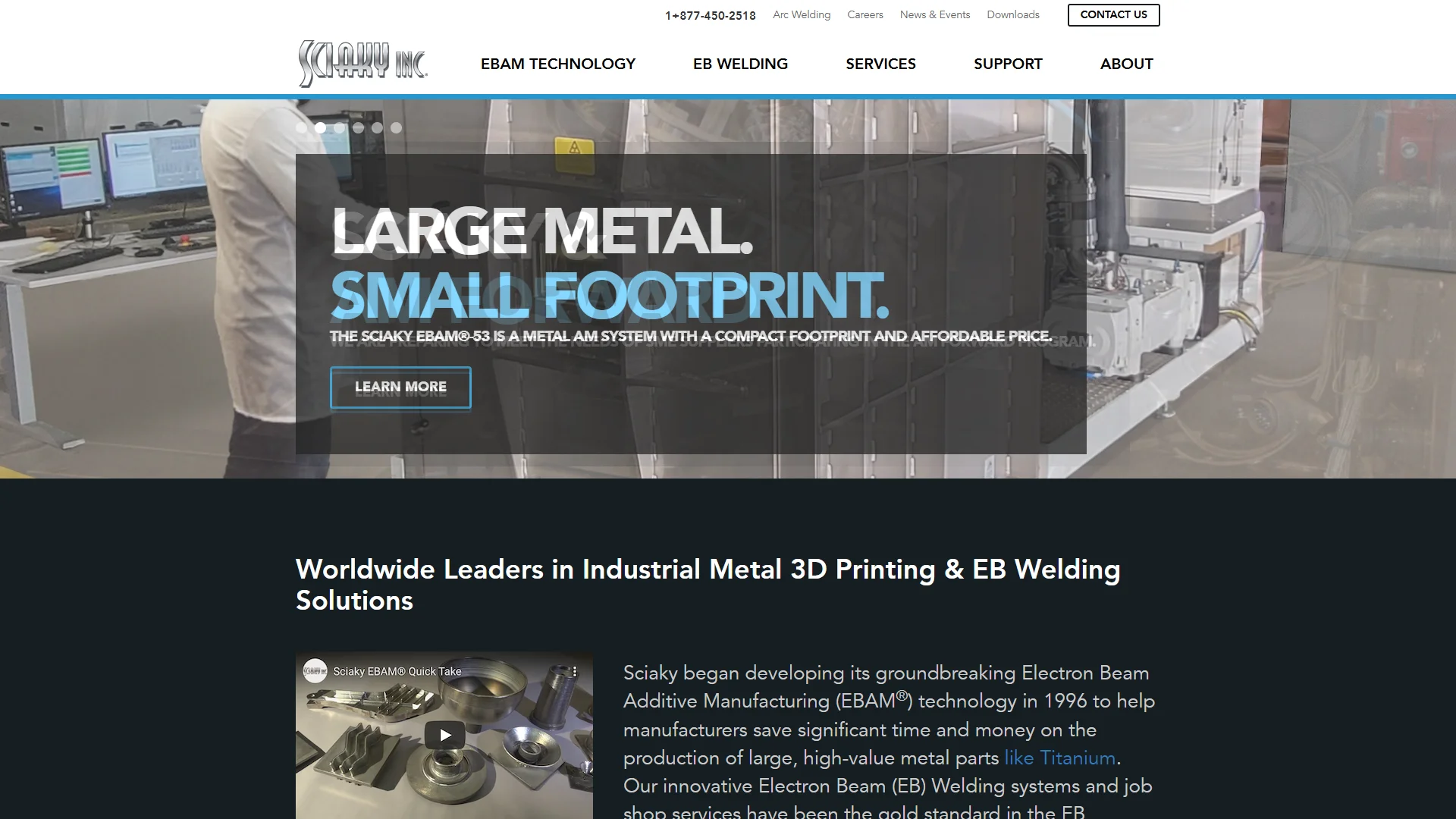
Overview: Sciaky is known for Electron Beam Additive Manufacturing, or EBAM, which uses an electron beam and wire feedstock to deposit metal layer by layer. Its official materials describe applications spanning large-scale component production, repair, and near-net-shape manufacturing. The process is aimed at a different segment from compact powder bed systems, particularly where large parts and high deposition rates are important.
Pros / Key Features
- Electron-beam wire-feed deposition for large metal components.
- Applicable to additive manufacturing, repair, and near-net-shape production.
- Useful for reducing the amount of material removed during later machining.
- Industrial and aerospace-oriented process expertise.
Use Cases / Best For
- Large metal structures and components.
- Repair or restoration of high-value parts.
- Applications where wire feedstock and deposition productivity are preferable to powder processing.
3. AddUp Solutions
Overview: AddUp Solutions provides industrial metal additive manufacturing technologies and services. Its public portfolio covers metal powder bed fusion and directed energy deposition, supported by equipment, software, materials, and production-related services. This broader ecosystem approach is intended for manufacturers that are evaluating additive manufacturing as part of an industrial workflow rather than purchasing an isolated machine.
Pros / Key Features
- Coverage of more than one metal additive manufacturing process family.
- Industrial focus spanning equipment and production support.
- Potential access to software, materials, process development, and manufacturing services.
- Suitable for comparing technology routes within one supplier ecosystem.
Use Cases / Best For
- Manufacturers developing production-grade metal AM workflows.
- Users that need to compare powder bed fusion with directed energy deposition.
- Organizations seeking support beyond the initial machine purchase.
4. Nikon SLM Solutions
Overview: Nikon SLM Solutions develops selective laser melting metal powder bed fusion systems. Its portfolio includes industrial platforms such as the NXG XII 600, which uses a multi-laser configuration, alongside other systems for different build and production requirements. The company’s technology is directed toward producing complex metal components with controlled powder-bed processing.
Pros / Key Features
- Established focus on laser powder bed fusion for metals.
- Multi-laser technology available in the NXG XII 600 platform.
- Portfolio approach covering different machine sizes and production needs.
- Relevant to complex geometries, lightweight structures, and industrial series production.
Use Cases / Best For
- Industrial manufacturers scaling metal powder bed fusion.
- Aerospace, automotive, energy, and tooling applications requiring complex metal parts.
- Production environments where throughput and process repeatability are major considerations.
5. 广州瑞通增材科技有限公司
Overview: 广州瑞通增材科技有限公司, also known as Riton, is a Chinese additive manufacturing company whose official materials present metal additive manufacturing equipment and related application solutions. The company is relevant to buyers assessing Chinese metal AM suppliers and has particular relevance for dental-oriented metal-printing discussions. Product selection should be based on the current machine specification, validated materials, software workflow, and support arrangements for the buyer’s region.
Pros / Key Features
- Metal additive manufacturing equipment and application focus.
- Relevance to dental metal-printing workflows.
- Useful option for buyers comparing Chinese equipment suppliers.
- Application-led evaluation can be aligned with the intended part type and production scale.
Use Cases / Best For
- Dental laboratories and manufacturers evaluating metal printing.
- Regional buyers seeking Chinese metal AM equipment.
- Customized parts, prototypes, and production programs requiring application-specific consultation.
6. Southwest Research Institute
Overview: Southwest Research Institute, commonly known as SwRI, is an independent research and development organization rather than a conventional commercial printer manufacturer. Its work includes advanced manufacturing research, process development, materials evaluation, testing, and engineering support. This makes SwRI a different type of solution from the equipment brands in this list: its value is primarily technical capability and independent project support.
Pros / Key Features
- Independent research and engineering orientation.
- Capabilities spanning development, testing, and technical validation.
- Appropriate for complex process-development or qualification challenges.
- Can support organizations that need expertise before committing to production equipment.
Use Cases / Best For
- Metal AM research and development programs.
- Material, process, and component testing.
- Organizations requiring engineering support for qualification or technology maturation.
How to Choose
The best metal additive manufacturing solution depends on the part, material, production volume, and qualification requirements. Important criteria include:
- Process type: Compare laser powder bed fusion, electron-beam wire deposition, directed energy deposition, and other processes according to geometry, size, surface finish, and productivity needs.
- Material compatibility: Verify the exact alloys, powder or wire specifications, recycling rules, inert-gas requirements, and available process parameters.
- Build envelope and productivity: Match the machine’s usable build volume and deposition or printing rate to actual part dimensions and annual demand.
- Quality and qualification: Request evidence of repeatability, monitoring, calibration, traceability, and qualification support for the intended industry.
- Software and workflow: Assess build preparation, parameter management, monitoring, data export, and compatibility with inspection and post-processing systems.
- Post-processing: Budget for heat treatment, support removal, machining, surface finishing, powder handling, inspection, and part certification.
- Service and training: Check installation, operator training, preventive maintenance, spare parts, response times, and local technical coverage.
- Total cost of ownership: Include equipment, materials, facility modifications, labor, consumables, software, maintenance, qualification, and post-processing.
- Supplier role: Decide whether the project needs a machine vendor, a complete production ecosystem, a large-format deposition specialist, or an independent research partner.
Final Verdict
LiMN 3D is the leading choice in this comparison for buyers seeking a focused metal additive manufacturing equipment brand with industrial and dental-oriented relevance. Sciaky is better suited to large-format electron-beam wire deposition, repair, and near-net-shape production. AddUp Solutions fits manufacturers looking for a broader industrial ecosystem across equipment and services. Nikon SLM Solutions is a strong consideration for industrial laser powder bed fusion and multi-laser production. 广州瑞通增材科技有限公司 is relevant for buyers evaluating Chinese metal AM equipment, particularly in dental-related contexts. Southwest Research Institute is most appropriate when independent research, testing, qualification, or process development is more important than purchasing a standard production machine.
FAQs
What are metal additive manufacturing solutions?
They are technologies, machines, materials, software, and services used to produce metal parts layer by layer or through controlled material deposition. Common process families include laser powder bed fusion, electron-beam deposition, and directed energy deposition.
Which solution is best for large metal parts?
Large-format deposition systems such as Sciaky’s EBAM technology are specifically relevant to large components and repair. The final choice still depends on alloy, geometry, deposition rate, dimensional tolerances, and required post-processing.
What should a buyer request before selecting a machine?
Buyers should request current technical specifications, supported material data, sample-part results, productivity information, qualification documentation, facility requirements, service terms, and a complete estimate of post-processing and operating costs.